-1.png?w=800&h=800)
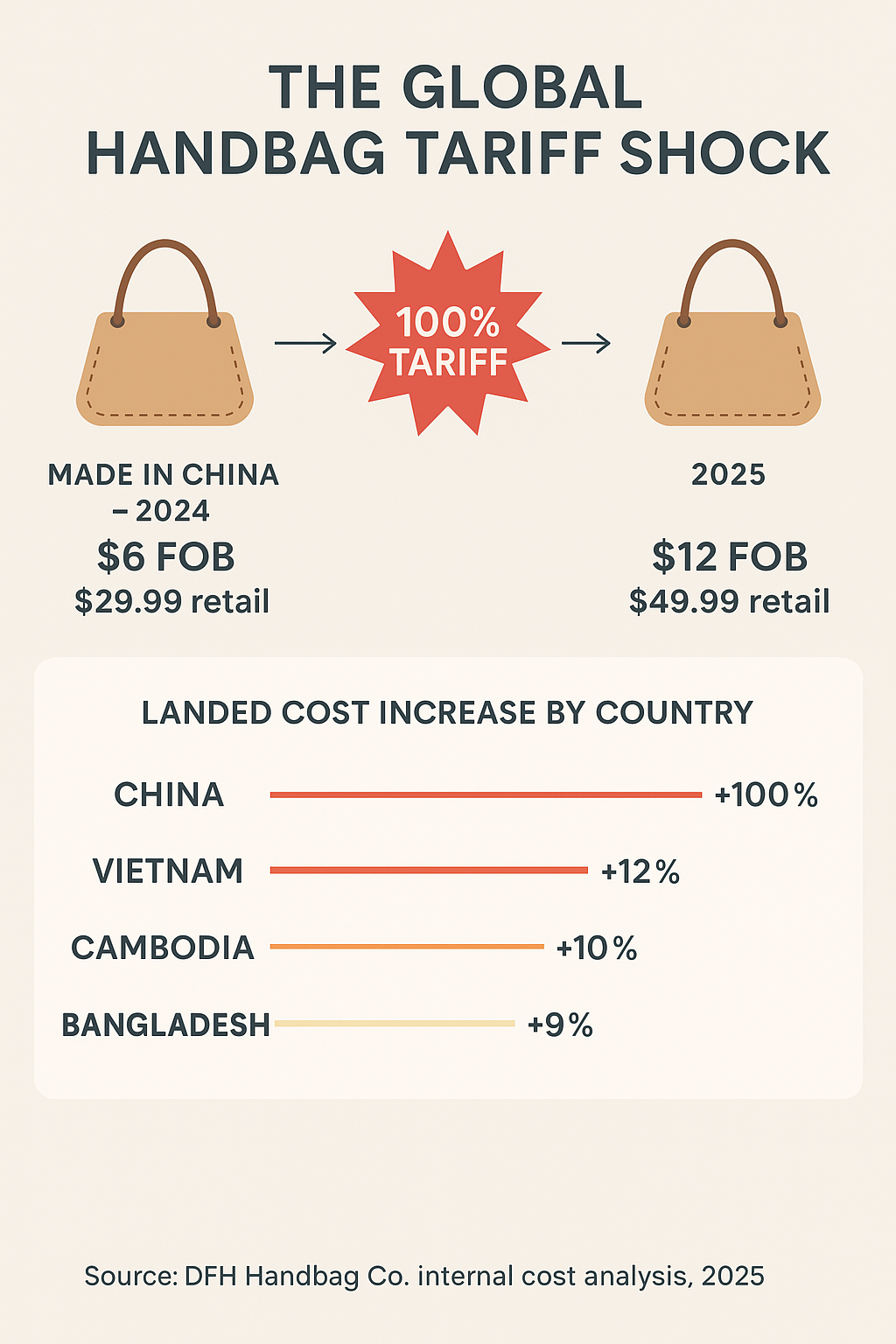
Starting November 1, 2025, China’s new export controls and the U.S. 100% import tariff on Chinese goods will reshape global supply chains — and handbags are at the center of the storm.
For handbag brands, importers, and OEM handbag manufacturers, this means rethinking sourcing geography, pricing, and delivery timelines just weeks before Black Friday 2025.
Key Takeaway
U.S.–China tariffs could double handbag import costs from China.
Diversified production in Southeast Asia keeps price stability before Black Friday 2025.
OEM handbag manufacturers with flexible layouts across multiple countries will hold a strong advantage.
The Trade Shock That’s About to Hit the Handbag Industry
On November 1, 2025, China will introduce export controls covering nearly all consumer products, while the U.S. will apply a 100% tariff on Chinese imports.
For years, China has been the engine of the global handbag supply chain — offering fast lead times, mature raw material access, and competitive pricing. But these twin policies will flip the industry overnight, just as retailers gear up for their biggest sales event of the year.
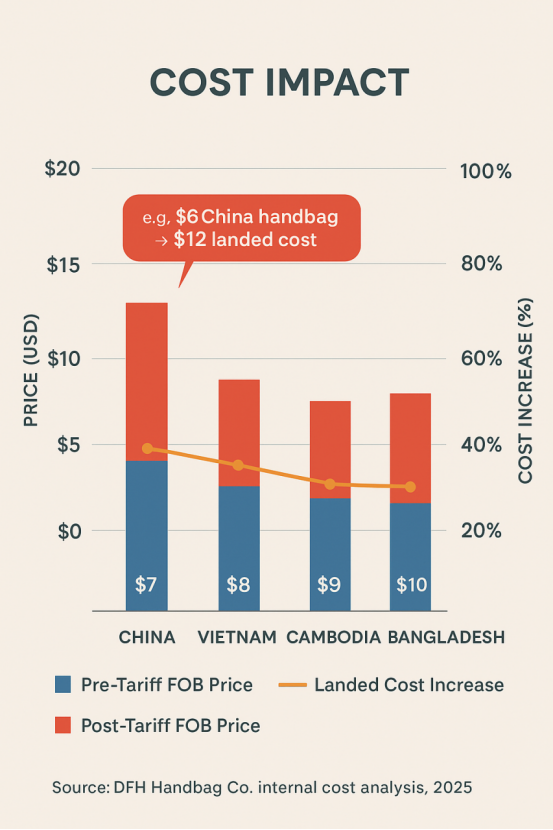
The Handbag Cost Shock Table (Example: Fashion Tote, MOQ 500 pcs)
|
Origin Country |
Base FOB (Before Tariff) |
Post-Tariff Estimated FOB |
U.S. Import Tariff |
Landed Cost Change |
|
China |
$4 – $10 |
$8 – $20 |
100% |
+100% |
|
Vietnam |
$5 – $11 |
$5.5 – $12 |
10–15% |
+10–15% |
|
Cambodia |
$5 – $11 |
$5.3 – $11.5 |
10–12% |
+10% |
|
Bangladesh |
$4.8 – $10.5 |
$5.1 – $10.8 |
9–12% |
+8–12% |
What It Means for Buyers and Retailers
Let’s put it simply:
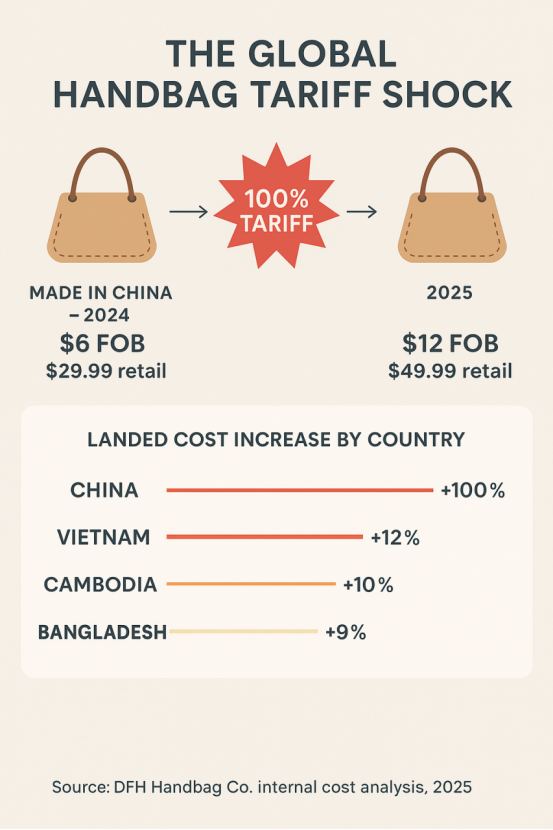
If you’re a U.S. handbag buyer preparing your Black Friday 2025 line, your go-to $6 China-made tote will now cost $12 before shipping.
Retailers will have two painful choices:
1.Raise retail prices — from $29.99 to $49.99, risking lower sales.
2.Absorb margin losses, reducing profit by up to 40%.
Meanwhile, handbag manufacturers in Vietnam, Cambodia, and Bangladesh will become the new sourcing hubs — if they can handle urgent production shifts in time.
Why Diversified Production Is the New Stability
At DFH Handbag Co., our long-term strategy of operating factories in China, Cambodia, and Bangladesh has proven essential.
This layout allows us to switch production bases within days, keeping samples, bulk orders, and shipment schedules stable for our clients.
It’s not just about cost — it’s about resilience and continuity in a volatile trade environment.
Brands that depend on a single-country supply chain will be forced into last-minute supplier changes. Those who already partner with OEM handbag manufacturers with multi-country capacity will ride through the disruption smoothly.
The Black Friday 2025 Countdown: Four Weeks to React
Here’s the timeline:
- Nov 1:Tariff begins — import costs double overnight.
- Nov 15–20:S. buyers finalize last-minute shipments.
- Nov 28 (Black Friday):Retailers face pricing chaos or sell-through shortages.
Online retailers like Amazon and Target will likely shift marketing narratives toward “Made in Cambodia” or “Ethically Sourced from Bangladesh” — turning supply chain diversification into a brand advantage.
Turning the Trade War into an Opportunity
While the new tariffs bring uncertainty, they also push the industry toward smarter sourcing, cleaner supply chains, and stronger partnerships.
Key advantages of multi-country OEM handbag manufacturing:
- Flexible response to policy changes
- Lower average landed cost across product lines
- Stable lead times during peak retail seasons
- Better transparency and ESG positioning
As the world approaches Black Friday 2025, one truth becomes clear:
In a volatile world, flexibility isn’t just smart — it’s survival.
D.F.H. Handbag Co., Ltd. - Like your brand, like mine