-1.png?w=800&h=800)
.jpg?w=500&h=500)
Most conversations about fashion bags start in a very direct way.
“How much is it per piece?”
“What’s the MOQ?”
“Can we try a small order first?”
These are all reasonable questions. From a brand perspective, they are usually the right starting point.
But if you spend enough time on the production side, something becomes quite clear over time:
What a bag looks like is often not a good indicator of how it is actually produced.
Especially in categories like cosmetic bags, totes, and everyday fashion bags, the difference between design intention and manufacturing reality can be surprisingly large.
When “simple” doesn’t always translate into “easy”
At first glance, it feels natural to assume that a simpler design should automatically mean lower cost.
Fewer materials. Cleaner shape. Less decoration.
And sometimes that assumption does hold true.
But in many real production cases, cost is not really driven by visual simplicity.
It is more influenced by how the product is constructed internally:
how many steps are involved, how materials interact, and how stable the process is when repeated at scale.
A cosmetic bag is a good example of this.
From the outside, it often looks like a small, simple pouch.
But depending on the structure, it can move between something very straightforward and something that requires quite a bit of coordination in production.
Cosmetic bags as a quiet example of hidden complexity
If you look closely at cosmetic bags across different brands, you’ll usually see several directions.
Some are very basic single-compartment styles. Others introduce internal dividers. Some go further with structured shapes, printed surfaces, or custom hardware.
Visually, they still sit in the same category.
But in production terms, they are not the same level of complexity.
The moment you start adding internal structure, multiple compartments, or customized branding elements, the production flow naturally becomes more layered.
Not necessarily better or worse — just more steps to manage.
And each additional step usually means a bit more coordination, a bit more dependency on materials, and a slightly higher chance of variation during production.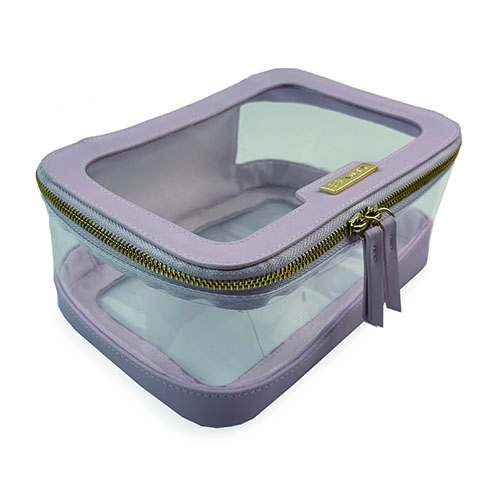
Why MOQ often feels disconnected from design expectations
MOQ is one of the areas that often creates confusion.
From the outside, it is easy to think MOQ is mainly about order size or pricing strategy.
But in practice, it is usually shaped by a set of upstream constraints that are not immediately visible in the design stage.
Fabric often comes with minimum order requirements.
Hardware usually has batch limitations.
Printing and branding processes require setup conditions.
Even production efficiency plays a role.
Because of this, it sometimes happens that a design which looks quite simple on paper still requires a relatively high MOQ in reality.
Not because it is difficult to make, but because the system around it needs a certain scale to operate smoothly.
What tends to work more consistently in real production
Over time, some patterns tend to appear more often in designs that scale well.
One of them is a more unified structure approach.
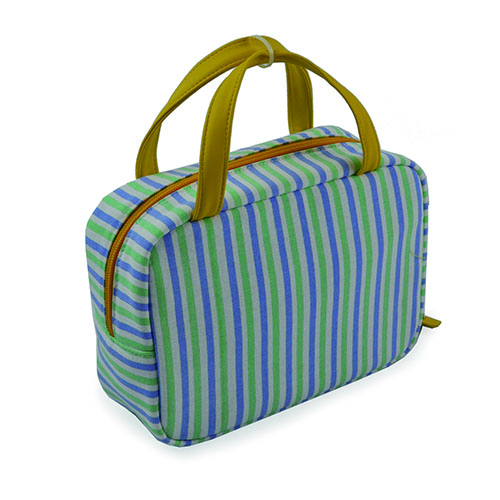
Bags that rely on a single main compartment or a clear, uncomplicated internal layout usually behave more predictably in production. This includes many tote bags, soft cosmetic bags, and everyday carry styles.
The advantage here is not just simplicity in appearance, but predictability in execution. Fewer components mean fewer variables during production.
Another direction is reducing reliance on rigid internal structures.
Instead of building shape through multiple reinforcement layers, some designs rely more on the natural behavior of the material itself. Softer structures, more flexible silhouettes, and fewer internal supports often lead to a smoother production process.
Hardware is another area that quietly affects the overall system.
Even small components like zipper pulls or metal logos introduce sourcing requirements and production dependencies. When these are simplified or standardized, the entire workflow tends to become more stable.
About sample orders and how they actually function
In many development processes, sample orders are used as a starting point. This is a very common and useful step.
But it helps to be clear about what they are meant to do.
A sample order is usually not about testing market demand or simulating small-scale sales. It is more about checking whether a design can actually move into production smoothly.
It helps confirm whether the structure works in real life, whether the materials behave as expected, and whether the design can be scaled without unexpected issues.
Sometimes a product looks completely fine in a few sample pieces, but behaves differently once it moves into larger production.
That is usually where sample testing becomes meaningful.
A more grounded way to think about bag development
Over time, many teams gradually shift their thinking from “how do we make this cheaper” to something slightly more practical:
whether the design can actually be produced consistently at scale.
Because a fashion bag is not only a visual concept.
It becomes a combination of material sourcing, production workflow, and repeatable manufacturing logic.
When these elements are aligned, cost tends to become more stable naturally.
Closing thought
In 2026, cost efficiency in fashion bags is less about pushing everything toward the simplest possible design.
It is more about finding a balance where design intention, production reality, and MOQ requirements can sit comfortably together.
Sometimes a slightly more structured design is actually easier to produce. Sometimes a very simple-looking bag requires more coordination than expected.
The difference usually lies in how everything connects behind the scenes.